A US dollar, carried in the coin itself.
QUSD is a fully-backed 1:1 US-dollar stablecoin. Every coin minted carries its own dollar of fiat inside its mint identifier and reads on chain — so a coin is never issued past its backing, and anyone can verify it without asking a bank.
The QUSD$ dollar — a dollar you hold
Every QUSD is a real, on-chain NFT dollar: unique, owned, transferable, and backed 1:1. The art and the backing are both written on chain — this is the live token, read straight from the contract.
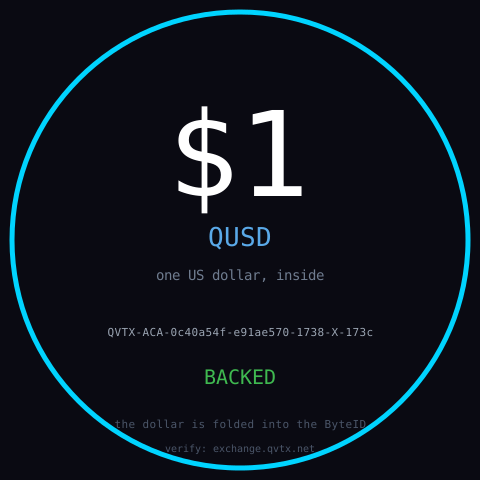
Renders anywhere
The dollar’s image and metadata are served over HTTPS as PNG, SVG and JSON, so it shows in any wallet, marketplace or page that opens a link — not just ours.
- PNG · SVG · metadata
- Other denominations: the full set
- Backing folded into the token’s own ByteID
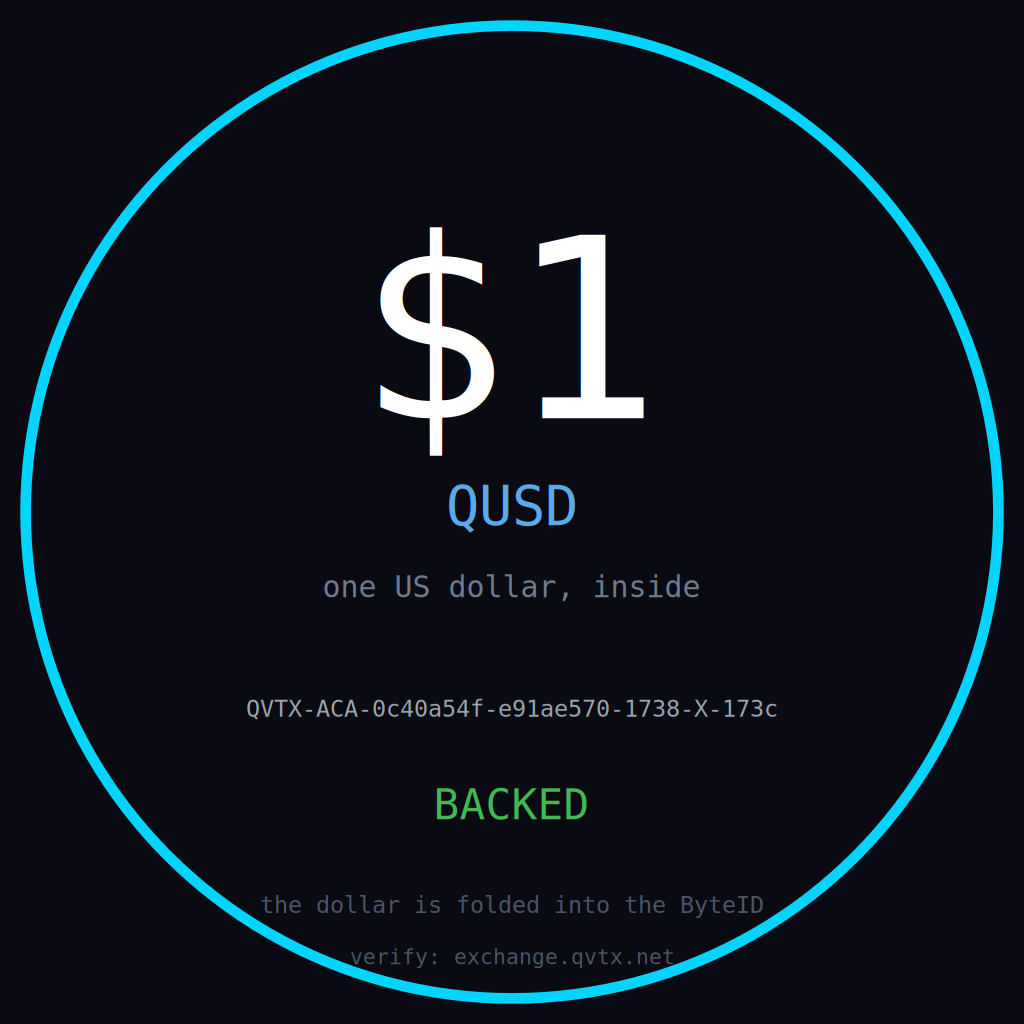
totalSupply() of every QUSD contract found on chain, summed at 18 decimals — if it is minted, it is a fiat.
What makes QUSD different
Most stablecoins ask you to trust a pool, a custodian and a quarterly attestation. QUSD puts the dollar inside the coin and lets anyone check it, any time, with no key and no bank. Each feature below pairs with the benefit it buys you.
Backing lives in the coin
Feature: each coin’s dollar of fiat is folded into its own mint ByteID at issuance — not a shared reserve pool, not a float waiting on a statement.
Benefit: there is no pool to drain, no float to misreport, and no moment where coins exist without their backing. Coverage is 1.0000 by construction.
Never issued past backing
Feature: a coin cannot be minted unless its dollar is committed in the same act.
Benefit: QUSD can’t be inflated behind your back. The supply you see on chain is the backing — they are the same number, by design.
Verify it without us
Feature: backing reads on chain via committedValue, every published figure carries its own recompute recipe, and anyone can fold a value at /reflect — all keyless.
Benefit: you never have to trust our word or wait for an auditor. You reproduce the number yourself; a mismatch is a finding, not a support ticket.
Par, always
Feature: QUSD is redeemable 1:1 at $1.00; the peg is the issuance price, not a market quote from a thin pool.
Benefit: no slippage games, no depeg from a shallow DEX. One coin is one dollar, in and out.
Everywhere it needs to be
Feature: one coin, deployed across six chains — QVTX 42000, Polygon, BSC, Base, Arbitrum and the XRP Ledger.
Benefit: settle where your counterparty already is, without wrapping or trusting a third-party bridge’s IOU.
Proven two ways
Feature: every backing record re-folds to exactly its recorded identifier across two independent channels — software and silicon.
Benefit: the attestation isn’t a PDF someone signed; it’s a computation that reproduces, live, on demand.
How QUSD is backed
Not a reserve pool, not a float waiting on a bank statement. Each dollar of backing is folded into the coin’s own mint identifier at issuance. The headline above is every coin minted; the narrower ByteID-pegged figure is the part a stranger can verify with two calls and no key.
1:1, in the ByteID
Every coin carries its own dollar of fiat inside its mint ByteID. Issuance can never exceed backing, so coverage is 1.0000 by construction — the question is whether the peg holds, not how large a ratio looks.
Readable on chain
Backing reads with committedValue(bytes8) on chain 42000 — selector 0x4058baa5 on the anchor registry. No API to trust, no bank to call.
No pool arithmetic
A single “reserve ratio” dividing one anchor across every chain’s supply was withdrawn on 2026-09-30 — it is not how QUSD is backed. Backing is measured per coin, per run.
Dual-channel verification
Each attested record re-folds to exactly its recorded identifier across two independent channels. —
Where QUSD lives
Every QUSD contract, on every chain, with its live supply, treasury-held balance and circulating amount — each read directly from chain with totalSupply() and balanceOf().
loading the register…
Verify it yourself
QUSD is built to be checked, not trusted. Everything below is keyless — no account, no API key, no cooperation from us.
Read the supply from chain. Call totalSupply() on each contract and compare to the table above. Don’t take our number — derive it.
Read the backing on chain. committedValue(bytes8) on chain 42000 returns the dollars committed to the anchor ByteID 03a151d702f5b734.
Pull the mint register. totals.json and circulating.json are the raw, per-contract figures this page is built from.
Fold a figure yourself. POST any payload to /reflect and confirm our engine lands on the same sense and shadow ByteID as yours.